
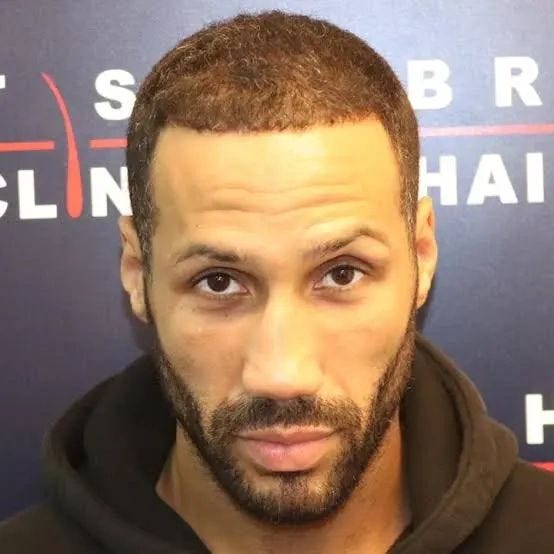
Being a lifelong boxing fan, it caught my eye that James DeGale is fighting tonight. I wish he wasn’t - he’s been retired since 2019, is now 40, and was very shopworn already at the end of his career. But I will see if I can find it anyway. For those that don’t follow the sport, he was an Olympic Gold Medallist for Britain, later became a world champion at super-middleweight, but never really found much affection with the public.
I think this was because he was an odd kind of personality onscreen. I always suspected this was a TV camera problem, that I would like him if I knew him, and yet whenever his fights came around I would watch the build-up with the same recurring thought: Oh James. Don’t do that…
He seemed to want to cultivate a streetwise persona, and some of the chat was arrogant to the point it turned people off. This itself is weird, because boxing has produced fighters vastly more arrogant, obnoxious and ridiculous than James DeGale, many of whom became enormously popular.
But with DeGale the confidence seemed skin deep, like he was trying to persuade you of something. I think, in truth, he actually had an important need to be liked, and with every appearance the chances seemed to recede further towards the horizon.
That became most obvious in the George Groves rivalry.
DeGale had every reason to be confident in the build up to their fight, which came early in both of their professional careers. He had won Olympic gold in Beijing and been identified as one of the outstanding talents of his generation. Groves was the old amateur rival who had beaten him before, but by the time they met as professionals DeGale clearly regarded himself as the star of proceedings.
And boy did he keep saying so… On the old TV station Boxnation they had a famous head-to-head in front of the cameras in which DeGale let Groves have it…. Groves was jealous. Groves was beneath him. Groves had lived in his shadow. DeGale was the Olympic champion and Groves was, memorably, the “ugly ginger kid” with bad breath.
Groves, for his part, played the situation perfectly. He sat there, looking slightly bewildered and a bit amused, and allowed DeGale to do the work of making sure that most fight fans wanted to see DeGale beaten.
I remember watching some of those exchanges and almost wanting to reach through the television, as this was so obviously the wrong psychological play for DeGale. “Shut up and sit there! You’re an Olympic champion – you don’t need to explain it!”
But he did explain it, about fifty times. And then some more. In the end, he lost to Groves on points in a close fight, with the crowd totally in the Groves corner. And I think that became part of the public’s permanent relationship with him. For shorthand we could call it arrogance, but that doesn’t capture it really. Truly colossal arrogance can actually be very charismatic. Think of Prince Naseem for example, entering arenas on flying carpets, predicting exactly how he’d destroy the next person. He’d routinely dance around, flip over the ropes, and talked about himself as though Muhammad Ali could have worked in his corner.
But, unlike DeGale, there was something completely self-contained about Naz. The whole thing worked because he didn’t appear to need your agreement. There was always the sense you could love him or hate him and that he would be easy either way as long as you bought your ticket.
With DeGale, I sometimes very strongly had the opposite impression. I thought he cared deeply about whether people cheered or booed, perhaps too much. The arrogance was a kind of defensive stance, not towards his opponent so much as an audience that he hadn’t clicked with fully. People just picked up on that.
There seems to be a strange rule of human interaction whereby the more obviously someone wants a particular response from you, the harder it becomes to give it naturally. Want to look relaxed and you start looking tense. Try very hard to be funny and nobody laughs. Want desperately to seem confident and people begin wondering why you need them to notice. DeGale seemed to fall into that trap over and over again, and that’s why I’d think “Doh!” in most of his fight buildups.
Which was a shame because the actual boxing career was extraordinary. As Olympic champion and world champion it was a far better career than the public vibe around him ever seemed to suggest. In the last years, unlike some of his peer group, there’s been no TV work on the big broadcasters for DeGale either. He is really a forgotten man.
A lot of his biggest wins seemed to come abroad, without those big domestic nights filling out a stadium in the UK, and so the moments that lodged most deeply in the public imagination were often the awkward losses: Groves, the unexpected loss to Caleb Truax, and eventually Chris Eubank Jr.
By the Eubank fight in 2019 DeGale truly no longer needed to convince anybody that he had achieved something, as he really had. If he’d have just set himself up to play the entirely natural elder-statesman version of himself that was by then fully available to him…? I think he would have had a much better chance in the fight. As it was, he delivered the same arrogant lines, often appealing to interviewers to “back him up” on the things he would say. This meant Eubank Jr – himself a marmite figure – was the overwhelming favourite of the crowd, and riding that wave his physicality was too much for DeGale at the end of his career. Having the crowd on his side could have been an important factor, but again he didn’t. A loss to someone he had described as “not a proper boxer”, technically rubbish, just not on his level, must have been a bitter pill. He retired a few days afterwards.
You wanted him simply to turn up with the authority of everything he’d done banked and in his back pocket. But instead it was the same person we saw in the Groves buildup, being arrogant but looking strangely out of his depth with it, and to my mind almost pleading with the audience to see the best in him.
Watching somebody across a whole career inevitably leaves impressions, and mine was always that the swagger wasn’t at all the whole man. There seemed to be something oddly vulnerable around the edges of it and I wished I could have had a fireside chat with him to think about these things. I always felt strongly we were seeing the worst version of him the moment the TV feed went live, and he probably reverted to being a great guy the second he left the TV studio.
I hope, sincerely, that whatever venue he is fighting in tonight will give the man a hero’s welcome. An Olympic champion who became a genuine world champion. A man who repeatedly travelled abroad to fight good opposition. An awkward, technically gifted southpaw who achieved much more than plenty of British fighters who were more enthusiastically loved.
Writing this I find myself warming to him even more. I still have a suspicion that the public version of James DeGale was simply not the best advertisement for James DeGale. Some fighters know instinctively how to make an audience love them. Some don’t care whether you love them at all. DeGale always struck me as belonging to a third, rather more human category that doesn’t do so well under the spotlights. I think he wanted us to like him. I, for one, do.